 Add to Chrome
 Add to Firefox
 Add to Edge
Semi-Supervised Noise Adaptation: Transferring Knowledge from Noise Domain
May 30, 2026
Transfer learning aims to facilitate the learning of a target domain by transferring knowledge from a source domain. The source domain typically contains semantically meaningful samples (*e.g.*, images) to facilitate effective knowledge transfer. However, a recent study observes that the noise domain constructed from simple distributions (*e.g.*, Gaussian distributions) can serve as a surrogate source domain in the semi-supervised setting, where only a small proportion of target samples are labeled while most remain unlabeled. Based on this surprising observation, we formulate a novel problem termed *Semi-Supervised Noise Adaptation* (SSNA), which aims to leverage a synthetic noise domain to improve the generalization of the target domain. To address this problem, we first establish a generalization bound characterizing the effect of the noise domain on generalization, based on which we propose a Noise Adaptation Framework (NAF). Extensive experiments demonstrate that NAF effectively leverages the noise domain to tighten the generalization bound of the target domain, leading to improved performance. The codes are available at https://github.com/AIResearch-Group/SSNA.

Fair Conformal Classification via Learning Representation-Based Groups
May 12, 2026Conformal prediction methods provide statistically rigorous marginal coverage guarantees for machine learning models, but such guarantees fail to account for algorithmic biases, thereby undermining fairness and trust. This paper introduces a fair conformal inference framework for classification tasks. The proposed method constructs prediction sets that guarantee conditional coverage on adaptively identified subgroups, which can be implicitly defined through nonlinear feature combinations. By balancing effectiveness and efficiency in producing compact, informative prediction sets and ensuring adaptive equalized coverage across unfairly treated subgroups, our approach paves a practical pathway toward trustworthy machine learning. Extensive experiments on both synthetic and real-world datasets demonstrate the effectiveness of the framework.
Uncertainty Quantification for LLM-based Code Generation
May 12, 2026Prediction sets provide a theoretically grounded framework for quantifying uncertainty in machine learning models. Adapting them to structured generation tasks, in particular, large language model (LLM) based code generation, remains a challenging problem. An existing attempt proposes PAC prediction sets but is limited by its strong monotonicity assumption on risk and single-label classification framework, which severely limits the space of candidate programs and cannot accommodate the multiple valid outputs inherent to code generation. To address these limitations, we propose an approach RisCoSet that leverages multiple hypothesis testing to construct risk-controlling predictions for LLM-based code generation. Given a trained code generation model, we produce a prediction set represented by a partial program, which is guaranteed to contain a correct solution with high confidence. Extensive experiments on three LLMs demonstrate the effectiveness of the proposed method. For instance, compared with the state-of-the-art, our method can significantly reduce the code removal by up to 24.5%, at the same level of risk.
Learning to Bid with Unknown Private Values in Budget-Constrained First-Price Auctions
May 10, 2026The transition to First-Price Auctions (FPA) in digital advertising has spurred significant research, yet existing work typically assumes access to a valuation oracle, ignoring the reality that values must be inferred from censored data. While Linear Treatment Effect (LTE) models address this by learning value uplift, they have not been adapted to realistic settings with hard Budget constraints or Return-on-Spend (RoS) targets requiring regret and violation control. In this work, we propose a unified primal-dual framework for constrained FPAs that jointly learns the latent LTE valuation parameters and the competitor's bid distribution. This simultaneous learning introduces a critical technical challenge: the estimation error is dynamically scaled by the Lagrangian multiplier, potentially leading to unbounded regret. We resolve this by leveraging a strong Slater condition and a novel adaptive burn-in procedure to stabilize the dual variables. Our approach achieves near-optimal regret guarantees, providing the first theoretically grounded solution for constrained bidding with latent valuations.
The (Marginal) Value of a Search Ad: An Online Causal Framework for Repeated Second-price Auctions
May 03, 2026Existing auto-bidding algorithms in digital advertising often treat the value of an ad opportunity as the revenue obtained when an ad is shown and/or clicked, and bid accordingly. This can lead to wasteful spending because the true value is the marginal gain from paid exposure: even without winning a sponsored slot, an advertiser may still earn revenue via an organic search result (e.g., on Google or Amazon). Motivated by recent work, we model ad value as a treatment effect--the outcome difference between winning and losing the auction--and study online learning for bidding in second-price (Vickrey) auctions under this causal perspective. We develop algorithms that attain rate-optimal regret under several feedback models. A key ingredient exploits the information revealed by the second-price payment rule, which strictly improves regret relative to analogous learning problems in first-price auctions.
CharTide: Data-Centric Chart-to-Code Generation via Tri-Perspective Tuning and Inquiry-Driven Evolution
Apr 24, 2026Chart-to-code generation demands strict visual precision and syntactic correctness from Vision-Language Models (VLMs). However, existing approaches are fundamentally constrained by data-centric limitations: despite the availability of growing chart-to-code datasets, simply scaling homogeneous chart-code pairs conflates visual perception with program logic, preventing models from fully leveraging the richness of multimodal supervision. We present CharTide, a novel data-centric framework that systematically redesigns both training and alignment data for chart-to-code generation. First, we construct a 2M-sample dataset via a Tri-Perspective Tuning strategy, explicitly decoupling training into visual perception, pure-text code logic, and modality fusion streams, enabling a 7B model to surpass specialized baselines using only supervised data. Second, we reformulate alignment as a data verification problem rather than a heuristic scoring task. To this end, we introduce an Inquiry-Driven RL framework grounded in the principle of information invariance: a downstream model should yield consistent answers to identical visual queries across both original and generated charts. Moving beyond rigid rule matching or VLM scoring, we employ a frozen Inspector to objectively verify generated charts through atomic QA tasks, providing verifiable reward signals based on answer accuracy. Experiments on ChartMimic, Plot2Code, and ChartX show that CharTide-7B/8B significantly outperforms open-source baselines, surpasses GPT-4o, and is competitive with GPT-5.
Stepwise: Neuro-Symbolic Proof Search for Automated Systems Verification
Mar 20, 2026Formal verification via interactive theorem proving is increasingly used to ensure the correctness of critical systems, yet constructing large proof scripts remains highly manual and limits scalability. Advances in large language models (LLMs), especially in mathematical reasoning, make their integration into software verification increasingly promising. This paper introduces a neuro-symbolic proof generation framework designed to automate proof search for systems-level verification projects. The framework performs a best-first tree search over proof states, repeatedly querying an LLM for the next candidate proof step. On the neural side, we fine-tune LLMs using datasets of proof state-step pairs; on the symbolic side, we incorporate a range of ITP tools to repair rejected steps, filter and rank proof states, and automatically discharge subgoals when search progress stalls. This synergy enables data-efficient LLM adaptation and semantics-informed pruning of the search space. We implement the framework on a new Isabelle REPL that exposes fine-grained proof states and automation tools, and evaluate it on the FVEL seL4 benchmark and additional Isabelle developments. On seL4, the system proves up to 77.6\% of the theorems, substantially surpassing previous LLM-based approaches and standalone Sledgehammer, while solving significantly more multi-step proofs. Results across further benchmarks demonstrate strong generalization, indicating a viable path toward scalable automated software verification.
Phi-Former: A Pairwise Hierarchical Approach for Compound-Protein Interactions Prediction
Feb 05, 2026Drug discovery remains time-consuming, labor-intensive, and expensive, often requiring years and substantial investment per drug candidate. Predicting compound-protein interactions (CPIs) is a critical component in this process, enabling the identification of molecular interactions between drug candidates and target proteins. Recent deep learning methods have successfully modeled CPIs at the atomic level, achieving improved efficiency and accuracy over traditional energy-based approaches. However, these models do not always align with chemical realities, as molecular fragments (motifs or functional groups) typically serve as the primary units of biological recognition and binding. In this paper, we propose Phi-former, a pairwise hierarchical interaction representation learning method that addresses this gap by incorporating the biological role of motifs in CPIs. Phi-former represents compounds and proteins hierarchically and employs a pairwise pre-training framework to model interactions systematically across atom-atom, motif-motif, and atom-motif levels, reflecting how biological systems recognize molecular partners. We design intra-level and inter-level learning pipelines that make different interaction levels mutually beneficial. Experimental results demonstrate that Phi-former achieves superior performance on CPI-related tasks. A case study shows that our method accurately identifies specific atoms or motifs activated in CPIs, providing interpretable model explanations. These insights may guide rational drug design and support precision medicine applications.
Prefill vs. Decode Bottlenecks: SRAM-Frequency Tradeoffs and the Memory-Bandwidth Ceiling
Dec 26, 2025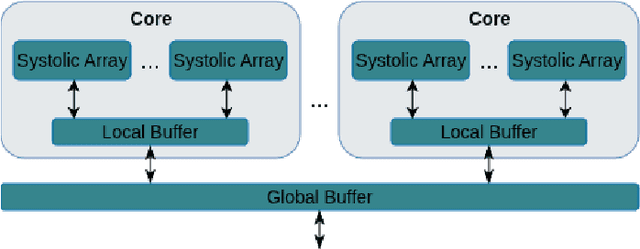

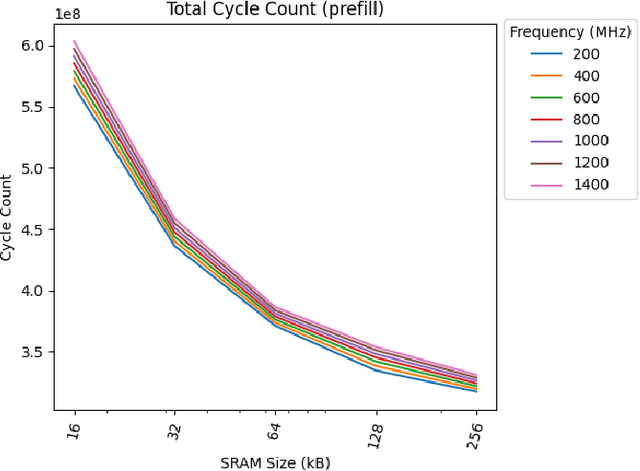
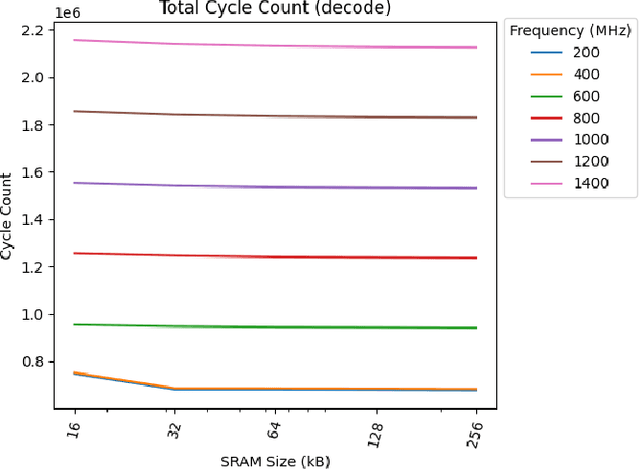
Energy consumption dictates the cost and environmental impact of deploying Large Language Models. This paper investigates the impact of on-chip SRAM size and operating frequency on the energy efficiency and performance of LLM inference, focusing on the distinct behaviors of the compute-bound prefill and memory-bound decode phases. Our simulation methodology combines OpenRAM for energy modeling, LLMCompass for latency simulation, and ScaleSIM for systolic array operational intensity. Our findings show that total energy use is predominantly determined by SRAM size in both phases, with larger buffers significantly increasing static energy due to leakage, which is not offset by corresponding latency benefits. We quantitatively explore the memory-bandwidth bottleneck, demonstrating that while high operating frequencies reduce prefill latency, their positive impact on memory-bound decode latency is capped by the external memory bandwidth. Counter-intuitively, high compute frequency can reduce total energy by reducing execution time and consequently decreasing static energy consumption more than the resulting dynamic power increase. We identify an optimal hardware configuration for the simulated workload: high operating frequencies (1200MHz-1400MHz) and a small local buffer size of 32KB to 64KB. This combination achieves the best energy-delay product, balancing low latency with high energy efficiency. Furthermore, we demonstrate how memory bandwidth acts as a performance ceiling, and that increasing compute frequency only yields performance gains up to the point where the workload becomes memory-bound. This analysis provides concrete architectural insights for designing energy-efficient LLM accelerators, especially for datacenters aiming to minimize their energy overhead.
Diffusion Transformer-to-Mamba Distillation for High-Resolution Image Generation
Jun 23, 2025
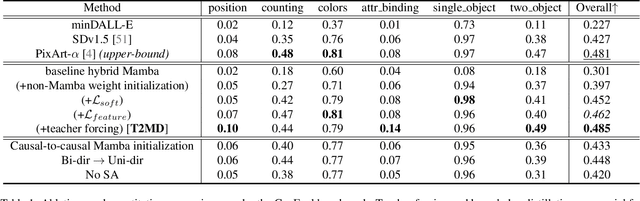
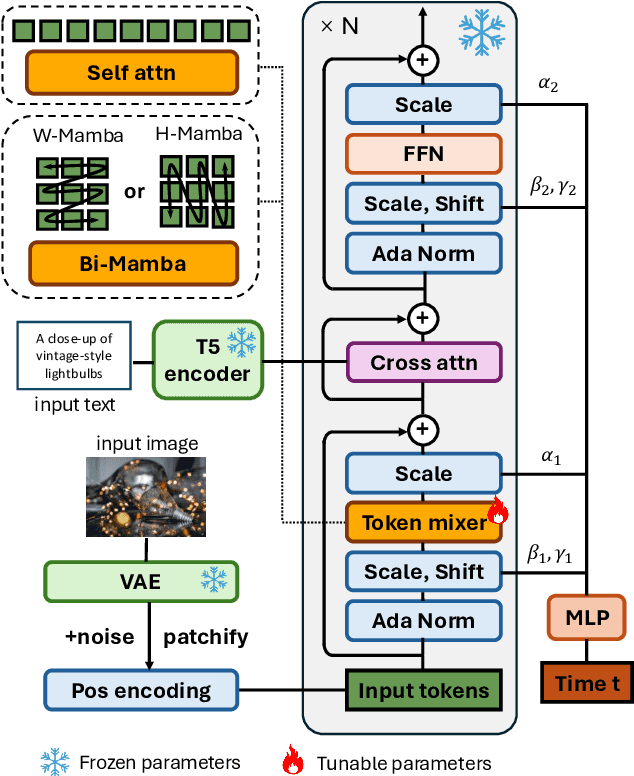
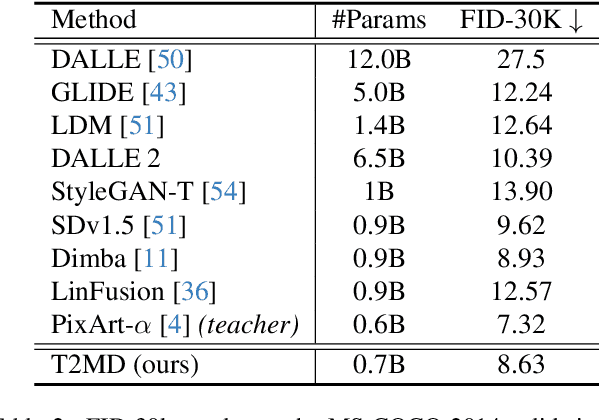
The quadratic computational complexity of self-attention in diffusion transformers (DiT) introduces substantial computational costs in high-resolution image generation. While the linear-complexity Mamba model emerges as a potential alternative, direct Mamba training remains empirically challenging. To address this issue, this paper introduces diffusion transformer-to-mamba distillation (T2MD), forming an efficient training pipeline that facilitates the transition from the self-attention-based transformer to the linear complexity state-space model Mamba. We establish a diffusion self-attention and Mamba hybrid model that simultaneously achieves efficiency and global dependencies. With the proposed layer-level teacher forcing and feature-based knowledge distillation, T2MD alleviates the training difficulty and high cost of a state space model from scratch. Starting from the distilled 512$\times$512 resolution base model, we push the generation towards 2048$\times$2048 images via lightweight adaptation and high-resolution fine-tuning. Experiments demonstrate that our training path leads to low overhead but high-quality text-to-image generation. Importantly, our results also justify the feasibility of using sequential and causal Mamba models for generating non-causal visual output, suggesting the potential for future exploration.